The Indibloggies
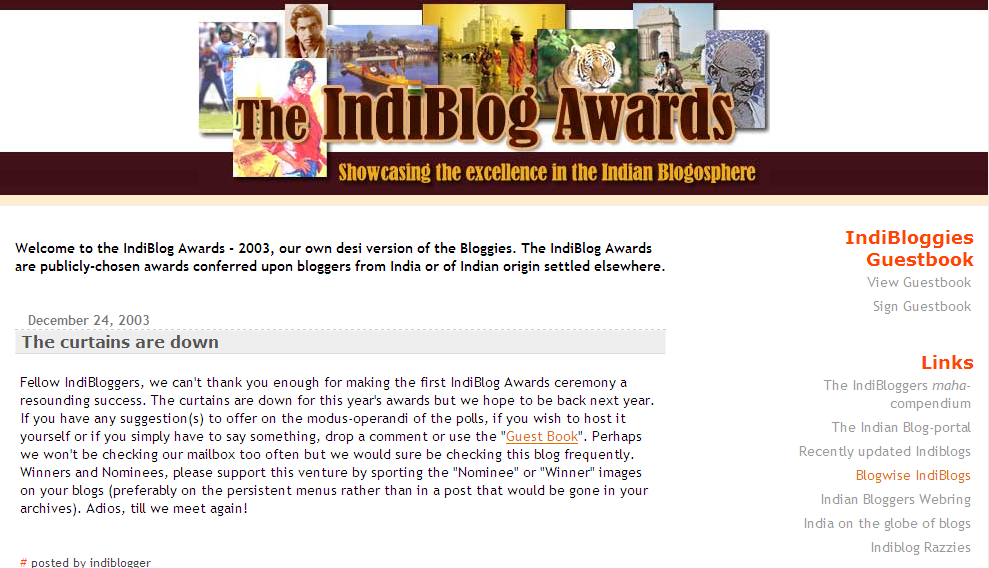
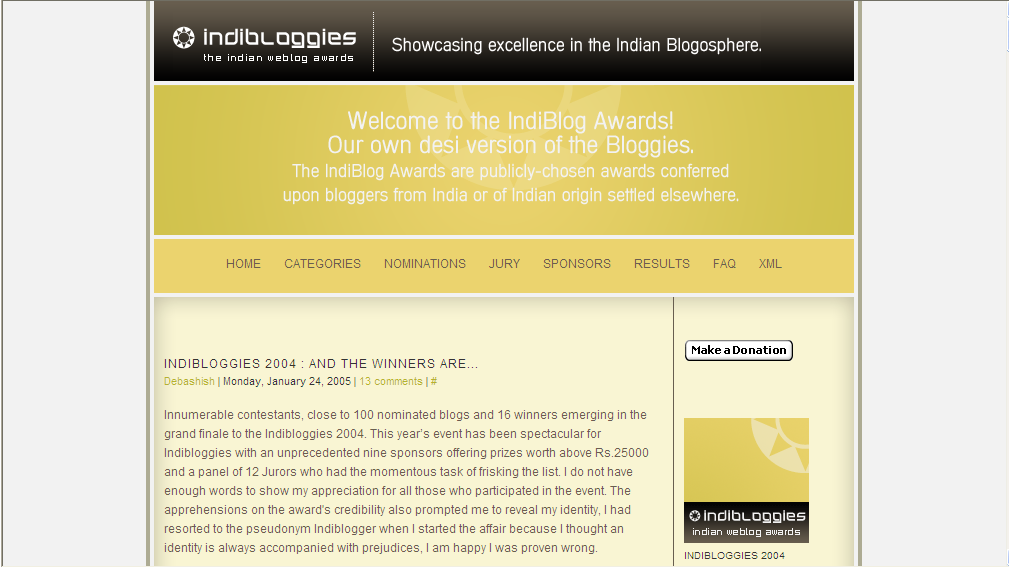
The Indibloggies was an annual blog-award clique for Indian Blogs. Indibloggies hosted 5 editions between 2003-2008 and became quite popular and is still regarded as prestigious by the winners.
Indibloggies.org was one of the earliest, most influential, and most community‑driven blog award platforms created for Indian bloggers and the Indian diaspora, active from 2003 through the late 2000s.1 2 Conceived and run by me, Debashish Chakrabarty, it combined public nominations, jury review, and online voting to highlight English and Indic‑language blogs and is still remembered as a prestigious recognition by many of its winners.3 4
Origins: From Backyard Clique to Community Hub
Indibloggies began in 2003, as a parody of the then popular international blog awards Bloggies, under the name “The Indian Weblog Awards,” at a time when blogging in India was still a relatively niche activity.4 5 I later described the initiative as “an annual blog‑award clique for Indian Blogs” that aimed to “showcase the best of the Indian blogosphere” and recognize blogs by Indians and the Indian diaspora in multiple languages.4
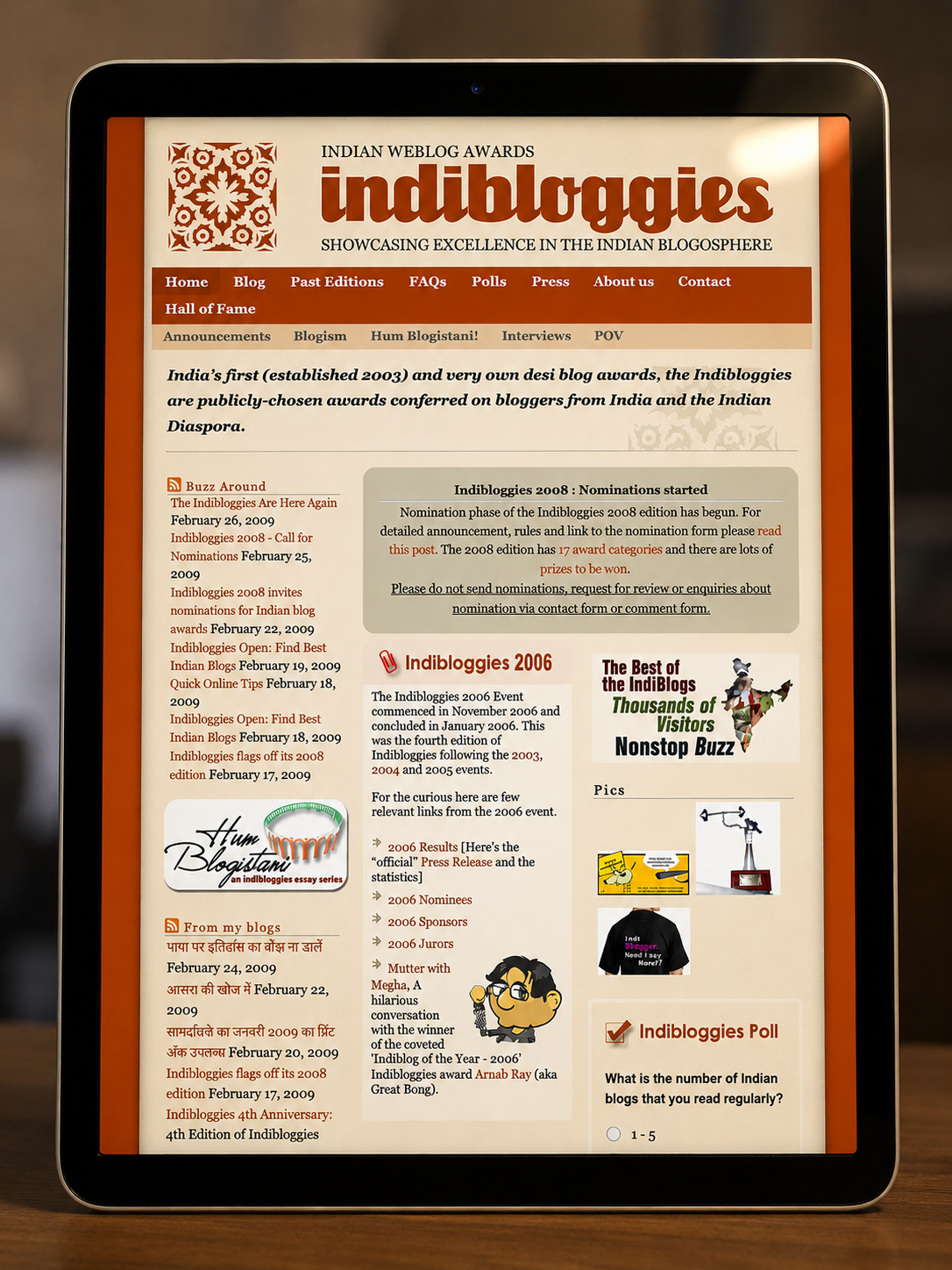
From its very inception, Indibloggies was a largely one‑person initiative supported by volunteer jurors and contributors rather than a formal organization. During the initial years I used a pseudonym “Indiblogger” for anonymity, but had to reveal my identity later.
In a farewell note published in April 2010, I recalled that Indibloggies had started as “a simple backyard fun clique in 2003” and remained “a one‑man driven effort” that survived thanks to the enthusiasm and participation of “umpteen fellow bloggers.”
Purpose and Positioning in the Blogosphere
Indibloggies positioned itself as a community‑centric awards platform rather than a commercial contest.1 6 Its stated objective was to provide a focal point for Indian blogging by recognizing quality work across genres and languages, thereby helping readers discover new voices in what Business Today in 2007 called “what could loosely be called the Indian blogging community.”1
The awards specifically targeted blogs authored by Indians or the Indian diaspora, encompassing both English and Indic‑language blogs. 2 This dual focus on geography and language distinguished Indibloggies from many contemporaneous international blog awards that concentrated primarily on English‑language content.4
Timeline and Editions (2003–2008)
Indibloggies hosted five main award editions between 2003 and 2008, with the event format evolving as participation grew.3
- 2003–2004: The early editions established the basic idea of annual Indian blog awards, with nominations and voting conducted informally among bloggers. I had not revealed my real name as the organizer at this time and was referred to simply as the “Indiblogger.”4 6
- 2005–2006: The awards matured into a more structured event, introducing formal categories, detailed nomination procedures, and a jury panel.
- 2007–2008: The later editions expanded category lists, emphasized Indic‑language segments, and drew thousands of votes in public polls, though they also became more demanding to run. 2
The 2008 edition, which concluded with results announced in December 2009, effectively marked the final cycle before Indibloggies formally closed in 2010. In the closure announcement, I noted that the 2008 awards had “stretched way too far” time‑wise, reflecting the increasing logistical burden of running a popular community event as a volunteer effort, and that I was also quite shaken by trolling and the huge amount of spam during the polls.
The Awards Model: Nominations, Jury, and Public Voting
Across its editions, Indibloggies relied on a hybrid process combining public nominations, expert jury review, and online polling. 4
The approach was a mix of “peer‑review from a panel of jurors, public nominations and public voting.”4 A detailed account of the 2006 edition on the Indibloggies blog illustrates how this worked in practice:
- Open Nominations: The 2006 nominations phase ran over 11 days and collected more than 700 nominations from the public.
- Jury Shortlisting: A panel of jurors reviewed the nominated blogs, ultimately shortlisting about 175 blogs out of roughly 290 actively considered for entry into the final polls.
- Public Polls: The final voting phase saw over 3,500 registrations and around 2,235 votes cast over a week, with winners chosen across 21 categories.
Jurors were asked not to participate in competition categories themselves, in order to maintain the perceived fairness and credibility of the awards. Business Today’s 2007 profile reinforced this picture, noting that the Indibloggies awards in their fourth year were decided “entirely through online polling,” emphasizing the importance of public voting in the final decision.1
Use of Del.icio.us and Early Social Web Tools
From 2005 onward, Indibloggies adopted del.icio.us, then a leading social bookmarking service, to streamline its nomination process.4 Public nominations were gathered via del.icio.us bookmarks tagged for specific categories, allowing participants to submit blog links in an open, distributed fashion; this was, to the best of my knowledge, a very novel way of using the bookmarking website at the time.4
Although many of the original del.icio.us pages are no longer easily accessible, my own documentation notes that “from 2005 onward Indibloggies used the social book marking site Del.icio.us to solicit category-wide public nominations.”4 The main awards blog, hosted on Blogger.com, also used external registration forms and poll mechanisms to manage nominations and votes, reflecting a DIY integration of early social web tools.
Categories and Emphasis on Indic Languages
One of Indibloggies’ distinctive features was its wide spread of categories and explicit emphasis on Indic‑language blogs. 2 The 2006 edition, which is documented in detail, showcased both genre‑based and language‑based awards.
Genre categories included:
- Indiblog of the Year
- Best Designed Indiblog
- Best Entertainment IndiBlog
- Best Food IndiBlog
- Best Group/Community IndiBlog
- Best Humanities Indiblog
- Most Humorous IndiBlog
- Best New IndiBlog
- Best Indi Photoblog
- Best Indi Podcast
- Best Science/Technology Indiblog
- Best Sports Indiblog
- Best Topical IndiBlog
- Best Travel Blog
In addition, specific language categories were created for Hindi, Kannada, Malayalam, Marathi, Tamil, and Telugu blogs, each with their own nominee lists. The organizers noted that Gujarati nominations were not considered in that year due to the absence of a juror for that category, and that no nominations were received for Bengali Indic blogs, showing that language categories were contingent on both community participation and available jury expertise.
This structured inclusion of multiple Indic languages differentiated Indibloggies from many global blog awards and aligned with my broader interest in promoting Indic language content online, which was also reflected in coverage of Indian‑language blogging and Indibloggies in publications like Dataquest and Asian Age.2 5
Visual Identity: Theme and Logo Design
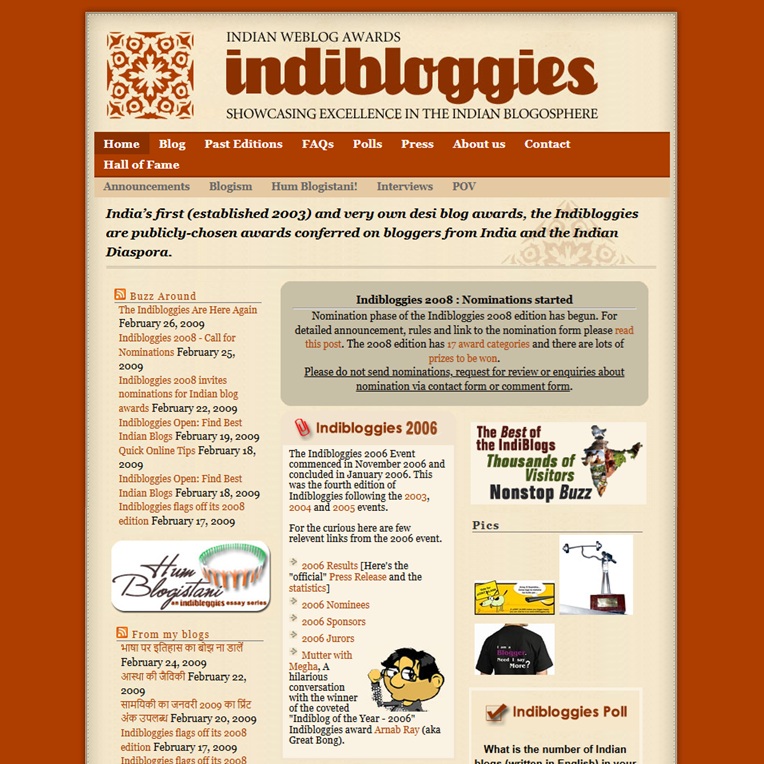
 Beyond its process and categories, Indibloggies developed a recognizable visual identity. The site’s theme and logo were designed, pro bono, by “the talented Bangalore‑based designer Hussain (popular as Chugs).”4 His use of Indian motifs and earthen colors brought dignity and a strong sense of Indian‑ness to the website.4 In his own words :
“I tried to avoid all cliches (Taj Mahal, the abused-to-death ‘Hindi English’ font, etc) and incorporated a decorative motif, reminiscent of the motifs you find in many of our clothes, saris and bindis.”
At the time, I hosted my own blogs on WordPress, and Chugs’ design helped the site get a consistent header, logo, and layout, which contributed to Indibloggies’ recognizability in an era when many blogs and small projects relied on default templates. This professional design helped mark Indibloggies as a distinct, curated space rather than just another personal blog.6
Notable Winners and Subsequent Achievements
Indibloggies gained a reputation for recognizing bloggers who would later achieve significant success in journalism and publishing.4 2 Notable examples:
Sonia Faleiro – Best Topical Blog (2005):
Sonia Faleiro’s blog was adjudged the “Best Topical Blog” at Indibloggies in 2005. In the same year, she won the CNN Young Journalist award, illustrating a trajectory from online recognition to mainstream journalistic acclaim.4 1 Sonia has written multiple books and is currently settled in London.4Amit Varma (India Uncut) – Best New Indiblog (2005):
Amit Varma’s blog “India Uncut” won the “Best New Indiblog” award in 2005. Varma subsequently won the Bastiat Prize for Journalism in 2007 and later secured a book deal with Hachette India, underpinning the role of early blog recognition in his public profile.4 He is now a well‑known podcaster.4Arnab Ray (Random Thoughts of a Demented Mind) – Indiblog of the Year & Most Humorous Blog:
Arnab Ray’s blog “Random Thoughts Of A De‑mented Mind” was a consecutive winner at Indibloggies, securing “Indiblog of the Year” and “Most Humorous Blog” across editions. He was inducted into the “Indibloggies Hall of Fame,” and later landed a book deal with HarperCollins which went on to become a bestseller.4 He has written multiple books since then, one of which was also adapted into a web series.4Rohin Dharmakumar – Indiblog of the Year (2003):
Rohin wrote under the pseudonym “Jivha” on a widely popular blog that was adjudged the “Indiblog of the Year” in 2003.4 He later wrote for Forbes and went on to co‑found “The Ken” in 2016, one of the earliest subscriber‑only business news websites from India.4
Indibloggies thus served not just as a community recognition mechanism but also as an early indicator of broader impact, foregrounding voices that later gained national and international attention.1 6
Popularity, Prestige, and Media Coverage
Indibloggies “became quite popular and was regarded as prestigious by the winners,” not least because the awards were granted by the blogging community itself through popular voting.4 The quantitative figures from the 2006 edition (hundreds of nominations, a sizable shortlist, and more than two thousand votes) support this characterization in the context of mid‑2000s Indian blogging. 2 Over the years, sponsorships also grew: in one of the later editions, about ₹70,000 worth of prizes were distributed to winners and voters through sponsored awards, as noted in mainstream coverage.
Mainstream media took notice as well. Business Today profiled the awards and described them as “well known” and as a focal point for Indian blogging.1 Pieces like “Battle of the Blog” in The Indian Express and “Blog Bytes” in The Asian Age highlighted Indibloggies’ role in surfacing Indian blogs across genres and languages.6 5
Hum Blogistani: Essays on the Indian Blogosphere
An important extension of the Indibloggies initiative was the essay series Hum Blogistani, which offered textual reflection from well‑known contemporary bloggers from the subcontinent on the state of Indian blogging.4 Through Hum Blogistani, Indibloggies functioned not only as an awards platform but also as a venue for self‑reflection and critical discourse about blogging, language, community norms, and media in South Asia.4
The essays were published between 2005 and 2007 and later compiled as a book comprising 10 pieces that provide “a bird’s eye view of the state of the Indian blogosphere during that period.”4
Buy on Amazon (Paperback & Kindle)Curtains Down
In the April 2010 farewell post on the Indibloggies blog, I wrote that my online activities were “not getting the required attention in my current scheme of things” and that the drawn‑out 2008 edition had highlighted the difficulty of running the awards. The post expressed gratitude toward jurors, sponsors, nominees, and readers, noting that “many still find it hard to believe that Indibloggies has been a one-man driven effort” and attributing its longevity to community support.
By officially “pulling its shutters down,” Indibloggies concluded a five‑edition run that had documented and celebrated the Indian blogosphere during a formative period.4
Visit Archived Website Read the Farewell Note
The Write way to Earn (Business Today, May 2007) ↩︎ ↩︎ ↩︎ ↩︎ ↩︎ ↩︎ ↩︎
Has an Indian blog touched you lately? (Economic Times, Dec 2005) ↩︎ ↩︎
I BLOG, so I am! (Sunday Herald, Jan 2006) ↩︎ ↩︎ ↩︎ ↩︎ ↩︎ ↩︎ ↩︎ ↩︎ ↩︎ ↩︎ ↩︎ ↩︎ ↩︎ ↩︎ ↩︎ ↩︎ ↩︎ ↩︎ ↩︎ ↩︎ ↩︎ ↩︎ ↩︎ ↩︎ ↩︎ ↩︎
Battle of the Blogs (Indian Express, Feb 2007) ↩︎ ↩︎ ↩︎ ↩︎ ↩︎
Gallery:
 with the Slogan chosen as part of community participation and voting.](/images/creations/creation-1-gallery-1.jpg)
 votes :)](/images/creations/IB_PointBlank_Promo.jpg)
 known then for creating art out of scrap, specially created this 'Scrapture' Trophy awarded at the Indibloggies 2006 edition to Arnab Ray in the 'Best Indiblog Category'.](/images/creations/IB_Scrapture_Trophy_Arun_Verma.jpg)
. It followed with an very [intereting interview](https://greatbong.net/2007/03/30/mutter-with-megha/) wigh Megha Murthy.](/images/creations/arnab_ray_vikram_nandwani.jpg)
. Very artistic indeed!](/images/creations/IB_Mutiny_Promo.jpg)